
 Több, mint 40.000 termék
For detailed information, other images and documents, please select individual articles from the following table.
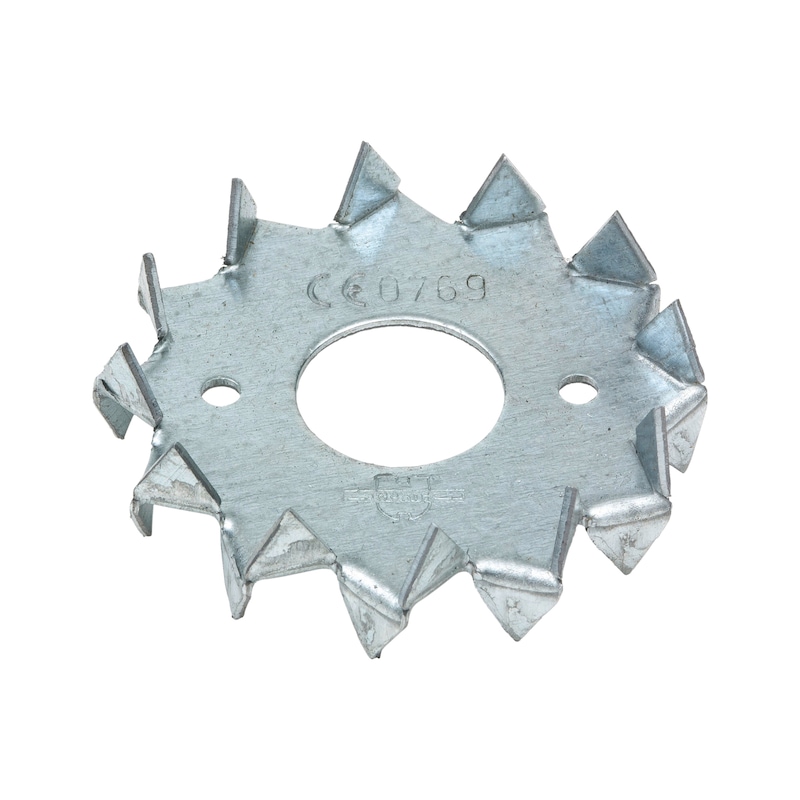
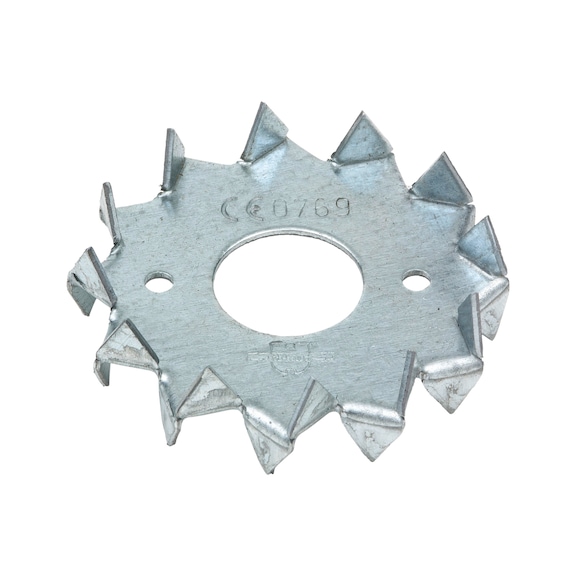
Double-sided tooth plate connector type C1
Double-sided tooth plate connectors (type C1) are used for wood-wood connections (softwood) in combination with bolts or wood screws to absorb shear forces. The bolts or screws subject to load absorb the clamping and tensile forces in the bolt axis.

Register now and access more than 125,000 products

Variants
Register now and access more than 125,000 products
Call customer service: (23) 418-130
Prices for customers after login
- In line with DIN EN 912:2011-09
- 2 nail holes, d = 3.5 mm
- Material: St 1203 or DC 01 + C390 steel in line with DIN EN 10139
- Surface: Sendzimir galvanised
- Application in utilisation classes 1 and 2
Transverse load in the compressed surfaces should not be higher than 2.5 N/mm2 for solid wood or 3 N/mm2 for laminated wood. Alternatively, double-shear connections can also be made using ASSY plus full-thread screws in combination with wheel head screws.
Used to manufacture double-shear, shear-loaded, softwood wood–wood connections e.g. half-lap joints, frame corners, collar beams, coupling purlins and grain-cut timber connections.
Double-sided tooth plate connectors, type C1, are attached using dowel pins and nuts. Alternatively, ASSY wood screws can be employed. Tooth plate connectors, type C1, can be used for grain-cut timber connections. Suitable fasteners are bolts and washers, ASSY 3.0 Combi screw with washer and ASSY 3.0 SK.
Assembly
1. Bore a hole for the bolt and nut in both timber components. The bore diameter for bolts in wood may only be max. 1 mm larger than the nominal diameter of the bolt.
2. Position the double-sided tooth plate connector. When using a double-sided tooth plate connector, the dowel must not touch the bolt. Fix the tooth plate connector in place using nails (d = 3 mm) inserted through the nail holes provided. The connector must not be driven in by hitting the teeth directly.
3. Drive in the tooth plate connector by tightening the bolt/bolt torque or using a hydraulic press-in tool. Alternatively, special driving tools can be used.
4. Tighten the bolts if the wood cross-section tapers.
Select RAL-colour code
!! NOTE: On-screen visualisation of the colour differs from real colour shade!!